What If Your Holiday Offer Isn’t Just About the Sale?
by Leah Wilkerson
A smarter way to think about products, services, marketing—and getting your business into new rooms.

I was on a call recently with Hayley Price White of The Art Coaching Club, a community and coaching resource for artists, when Hayley shared an idea that immediately made me think beyond the art world. She encouraged artists to think about the holiday season not simply as a selling season, but as a marketing season.
That distinction stuck with me. Because whether you sell paintings, jewelry, books, scarves, design services, coaching, food, flowers—or something entirely different—the question may not simply be: How much money can I make from this? There may be another question worth asking: How many new people could this introduce to my business?
Some Things Make Money. Some Things Plant Seeds.
Hayley described holiday offerings in two broad categories: money makers and seeds.
Money makers are fairly easy to understand. They're the products or services that generate meaningful revenue and have a healthy return for the time, energy and money you put into them.
But the idea of seeds is where things get interesting. A seed may be a smaller, more accessible or highly giftable offering. It still needs to make financial sense, but its value isn't measured entirely by the profit from that first transaction. Because it can travel.

An artist sells an ornament to a collector, who gives it to her sister.
A baker creates a beautiful holiday box that lands on the desk of a potential corporate customer.
An author gives people an easy way to gift her book.
A jewelry designer creates a small piece at an accessible price point that introduces someone to her larger collection.
A consultant offers a workshop that gives ten new people a taste of what it's like to work with her.
A designer creates a useful downloadable guide that gets forwarded to a friend.
One customer has suddenly introduced your work to another person.
That's a seed. And some of those seeds eventually become customers, collectors, referrals, collaborations or opportunities you couldn't have predicted.
But “Accessible” Shouldn't Mean “Cheap”

Another point Hayley made was especially important for artists, but I think it applies to almost every creative business: Your lower-priced offerings should still feel like you. You don't need to create something cheap simply because you're trying to reach more people. In fact, that can work against you. If you've built a thoughtful, beautiful, distinctive brand, your $25 product should feel just as intentional as your $2,500 product.
The same applies to a service business. A free guide shouldn't look like something you threw together in 20 minutes. A small workshop should give people a glimpse of the quality they would receive if they hired you. A sample should make someone want more. The goal isn't necessarily cheap. It's accessible—and excellent.
What Could Become Your Tradition?
The conversation also turned to artists who create limited-edition ornaments each year. Instead of thinking of them as simply another Christmas product, some artists have turned them into annual collectibles. Customers begin to anticipate them.
What's this year's design? — When is it coming out? — I have the last three—I want this one too.
And that made me wonder: What could become a tradition in your business? It doesn't have to be an ornament.
Maybe it's an annual holiday collection. — A special recipe box. — A December workshop. — A yearly print. — A seasonal scarf. — A gift set. — A holiday home consultation. — A “favorite things” guide your customers look forward to every year. — A limited edition available only for a few weeks.
We spend so much time trying to invent the next new thing that sometimes we overlook the power of creating something people want to return to.
Don't Put Everything on the Table at Once
This may have been one of my favorite practical reminders from the conversation. Many small-business owners work like crazy preparing for the holidays and then suddenly announce: IT'S ALL HERE!
New products. — Gift sets. — Events. — Specials. — Workshops. — Holiday shipping. — Twenty-seven Instagram posts.
And then we wonder why nobody noticed half of it. Instead, think about giving each idea room to breathe.
Introduce one thing. — Tell us why you created it. — Show us behind the scenes. — Tell us who it would make a wonderful gift for. — Show us how someone is using it. — Share the story again from another angle.
Then introduce the next thing. You don't necessarily need more things to talk about. You may need to talk more about the things you already have.
Your Customer Hasn't Seen Nearly as Much as You Think
That idea came up again later in the call when an artist said she felt like she'd talked about a project so much that she was becoming bored with herself. Hayley's response was a great reminder: The artist sees everything. The audience sees a fraction of it.
We experience the idea, the planning, the mistakes, the revisions, the finished product, the photography, the website listing and every Instagram post. Our customers don't. Which means the story you are tired of telling may still be brand-new to them. And one story can contain dozens of smaller stories.
Instead of telling the entire story in one post, tell us:
Why you started. — What surprised you. — What didn't work. — What changed. — What your customer said. — What you would do differently. — What detail we might have missed. — What the finished product means to you. — How someone is using it. — What you're working on next.
One idea does not equal one piece of content. One idea can fuel weeks of meaningful communication.
Let People See How You Think
There was another piece of advice from the call that I loved. Show the work before it's finished. Artists sometimes hesitate to do this because—what if the painting doesn't work? But isn't that true in every business?
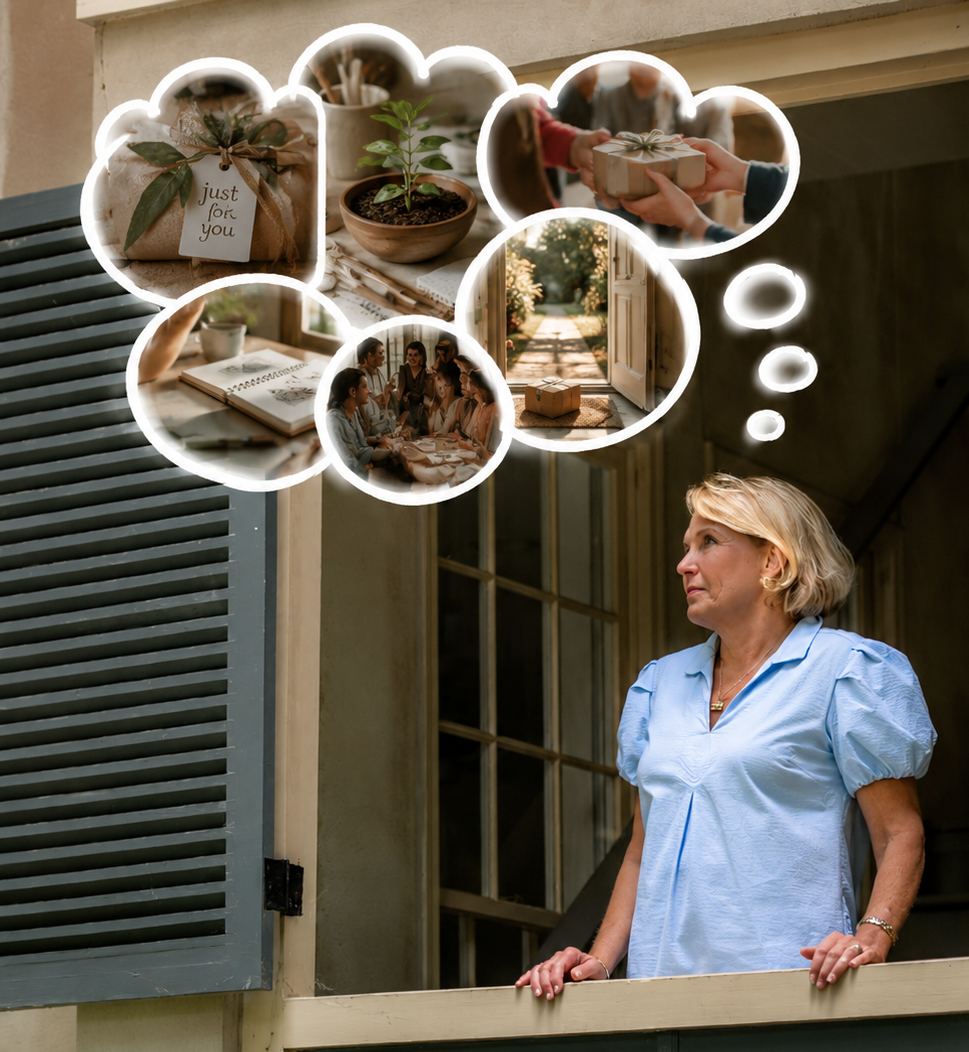
What if the idea changes? — What if the product doesn't sell? — What if the event doesn't work?— What if we try something and decide never to do it again?
That's business. And sometimes the process is far more interesting than the polished result. People are curious about how other people think.
Why did you change the packaging? — Why did you choose that color? — How did you decide to offer this service? — What made you abandon the first idea? — What are you trying to figure out right now?
You don't always have to show up as the expert standing at the finish line. Sometimes it's much more interesting to invite people into the middle.
So, What Does This Have to Do With W4W?
A lot. These are exactly the kinds of conversations I want us to have inside Women for Women.
An idea shared with a group of artists can spark an entirely different idea for a retailer.
A marketing strategy used by a jewelry designer might work beautifully for an author.
A productivity idea from a consultant might completely change the way an artist structures her week.
A pricing conversation might make all of us rethink how we're presenting the value of what we do.
We don't all need to be in the same business to learn from one another. In fact, sometimes it's better that we're not. The magic happens when we take an idea from one world and ask, “How could this work in mine?”
That's one of the things we're building at W4W: a place where women can bring what they're learning, share what's working, ask questions, experiment and help each other see possibilities we might not see on our own.
So here's something to think about: What are your money makers? What are your seeds? And perhaps the most interesting question: What could you create—or reposition—that gets your business into a room it isn't in today?
This post was inspired by a recent coaching conversation led by Hayley Price White of The Art Coaching Club. Hayley works with artists on the business, marketing, and strategic side of building an art career. We're grateful for the ideas and perspective she shared—and for the reminder that good business lessons often travel far beyond the industry where we first hear them.