Maybe You’re Not an Imposter. Maybe You’re Growing.
What Self-doubt May Be Trying to Tell You?
Have you ever walked into a room and immediately wondered whether you belonged there?
Everyone else seems comfortable. They appear to know one another, understand what is happening, and possess some level of confidence you somehow missed.

You begin thinking:
“Everyone else knows what they’re doing.”
“I’m not experienced enough.”
“I shouldn’t be here.”
“Soon they’re going to figure me out.”
That feeling is often called imposter syndrome.
It is usually discussed in connection with careers and professional success, but it can appear in almost any area of life. It can happen when you join a new group, try something creative, begin dating again, become a parent, return to work, volunteer for a leadership role, or enter a season you have never navigated before. It often shows up when we are learning, stretching, or becoming someone we have not been before.
What Imposter Feelings Look Like.
Psychologists Pauline Clance and Suzanne Imes first described the “impostor phenomenon” in 1978 after working with accomplished women who struggled to believe they had earned their success. Even when evidence showed that they were capable, they credited luck, excessive effort, charm, or someone else’s mistaken judgment. (Read their article HERE.)
That disconnect can happen to any of us.
Other people see courage. We remember how afraid we were.
Other people see ability. We focus on everything we still do not know.
Other people see the finished result. We remember the mistakes, revisions, hesitation, and help it took to get there.
We assume that capable people should feel certain. Then, when we feel uncertain, we treat that feeling as proof that we are not capable.
But confidence and competence are not the same thing. A person can be confident and unprepared. A person can also be thoughtful, capable, and experienced—and still feel nervous walking into an unfamiliar room.
Why Do We Feel Like Imposters?
Sometimes it begins with comparison.
We see someone speaking confidently but do not see how much she prepared.
We see a close friendship but not the years it took to build.
We see a beautiful painting but not the discarded attempts.
We see someone handling a difficult season with grace but not the private moments when she feels frightened or exhausted.
We compare our internal experience to someone else’s external presentation.
Then we decide: “She is the real thing. I am pretending.”
Imposter feelings can also grow from the standards we set for ourselves.
Dr. Valerie Young, author of The Secret Thoughts of Successful Women, describes this as our personal competence rulebook—the hidden rules we believe we must follow to consider ourselves capable.
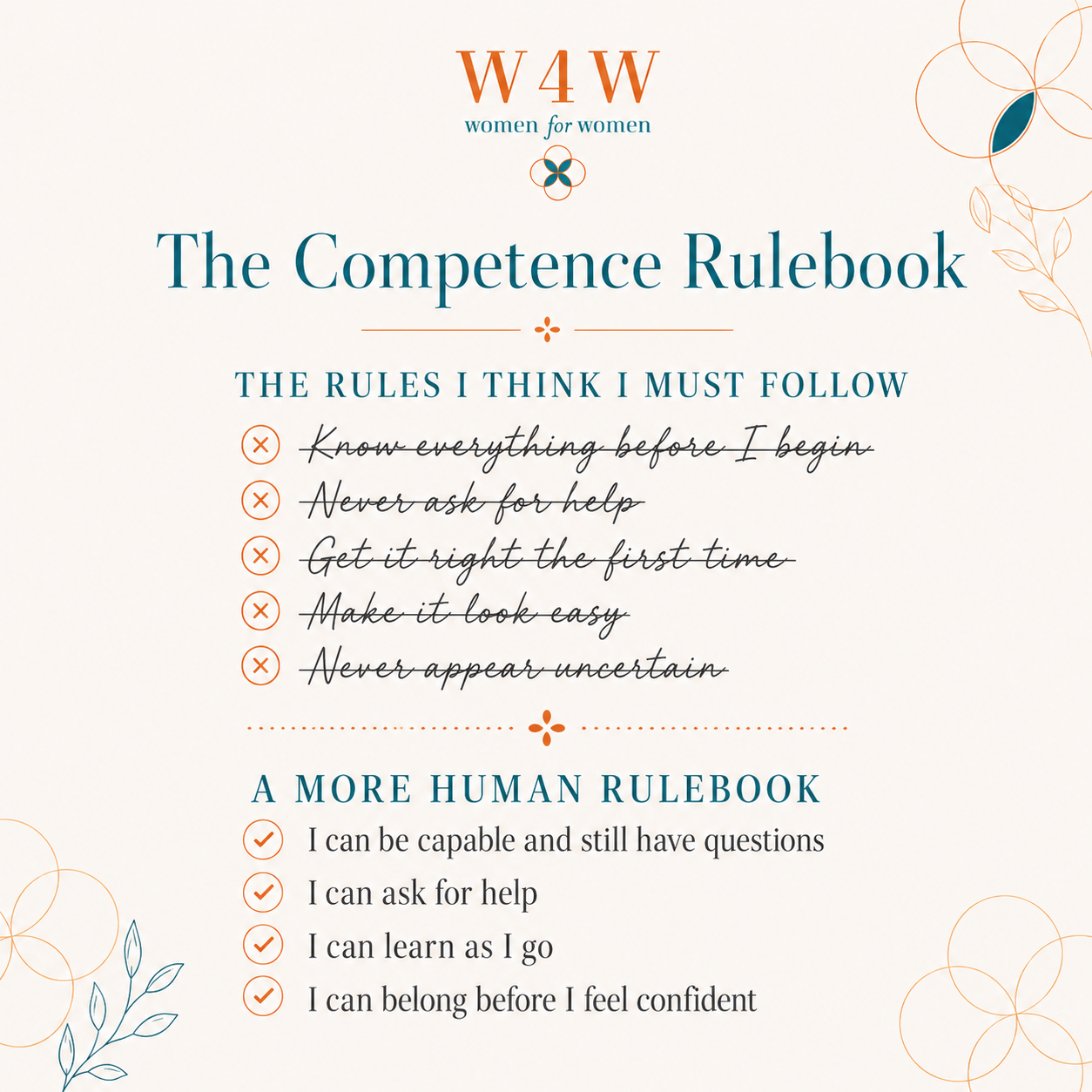
Those rules may sound like:
“I should already know how to do this.”
“I should not need help.”
“If I were truly talented, this would come naturally.”
“One mistake means I am not ready.”
“I should be able to manage everything without letting anyone down.”
Those are not reasonable expectations. They are impossible ones.
Learning requires not knowing. Growth requires trying things we have not mastered. Belonging somewhere new may feel awkward before it feels natural. Difficulty is not always evidence that we are in the wrong place.
Sometimes it is simply evidence that we are new.
How to Recognize It
Imposter feelings do not always announce themselves with the words “I feel like a fraud.”
They can look like procrastination because beginning creates the possibility of being judged.
They can look like overpreparing because we believe we must anticipate every question and prevent every mistake.
They can look like perfectionism because nothing we produce feels quite good enough to share.
They can look like dismissing praise: “They’re just being nice”, “Anyone could have done that”, “I got lucky”, or “It really wasn’t a big deal.”
Imposter feelings can also keep us quiet. We do not ask the question. We do not introduce ourselves. We do not share the idea. We do not apply, volunteer, create, or participate because we are waiting to feel completely ready.
But complete readiness may never come.
Sometimes confidence develops only after we begin.
What Is the Feeling Pointing Toward?
What if we stopped treating imposter feelings as a final verdict and started treating them as information?
Instead of asking: ”What is wrong with me?”
Try asking: ”What is this feeling pointing toward?”
Perhaps you need more information.
Perhaps you need practice.
Perhaps you need encouragement from someone who has been there before.
Perhaps you are comparing your beginning to someone else’s tenth year.
Perhaps you need to ask for help instead of believing that help disqualifies you.
Perhaps you are holding yourself to a standard you would never place on another person.
Or perhaps the room itself has not made you feel welcome.
That last possibility matters.
Writers Ruchika Tulshyan and Jodi-Ann Burey caution against treating every experience of not belonging as an individual confidence problem. Sometimes people doubt whether they belong because they are receiving real messages of exclusion, bias, or dismissal. In those cases, the answer is not simply for the individual to become more confident. The environment must also be examined. (Read their article HERE)
Not every uncomfortable feeling is asking for the same response.
Sometimes we need preparation.
Sometimes we need support.
Sometimes we need a more realistic expectation.
Sometimes we need to give ourselves permission to be beginners.
And sometimes we need a better room.
Examine Your Own Rulebook
When you begin feeling like an imposter, ask yourself: “What do I believe I must do to prove I belong?”
Do I believe I must know everything?
Never make a mistake?
Do it without help?
Be immediately good at it?
Appear confident at all times?
Then ask: “Would I expect this from anyone else?”
We often allow other people to learn, ask questions, change direction, and make mistakes. But when it comes to ourselves, we mistake imperfection for exposure.
A more human rulebook might say:
I can be capable and still have questions.
I can belong and still feel uncomfortable.
I can ask for help and still take pride in what I accomplish.
I can be new without being inadequate.
I can make a mistake without becoming one.
I do not have to feel confident before I begin.
Say It Out Loud
One of the most powerful ways to loosen imposter feelings is to talk about them.

Clance and Imes found in their early work that group conversations helped women recognize how common these hidden doubts were. A woman might struggle to acknowledge her own abilities while clearly seeing that another woman was unfairly discounting hers. (Pauline Rose Clance)
There is something freeing about hearing a woman we admire say: “I have felt that way too.”
It reminds us that confident-looking people still have doubts. Capable people still question themselves. And belonging does not always arrive as a feeling before we participate.
Sometimes we begin to feel that we belong because we stayed.
Beginning the Conversation
This fall, we will begin our first W4W Conversation with a discussion about imposter syndrome.
We will hear from women with different backgrounds and experiences—women who have stepped into new rooms, taken risks, started over, learned unfamiliar skills, and questioned themselves along the way. Not because they have eliminated self-doubt forever. But because honest conversations help us recognize what self-doubt sounds like, what may be feeding it, and how we can continue moving even when it comes along.
Perhaps imposter feelings are not always proof that we are in the wrong place. Perhaps they sometimes appear because we are stretching beyond what is familiar.
The question may not be: “How do I make sure I never feel this again?”
A better question might be: “What is this feeling trying to tell me—and does it deserve to decide what I do next?”
You may still have questions. You may be learning as you go. You may not feel completely ready. But none of that means you do not belong.